Need software built?
Skip assembling a team.
A customer-facing application, an internal tool, a SaaS product or a backlog you have been postponing. We take it from requirements through implementation and verification — and you work with a small delivery team backed by the LFG software factory instead of paying for a large one for months.
Your repository · your code · a written spec before anything is built
What we build
Four shapes of work, one delivery process.
Build a new product
A product with real users, not a prototype you throw away in three months.
- Customer-facing applications
- SaaS products
- Authentication, payments, integrations
- Infrastructure and deployment
Clear a backlog
The work your team keeps meaning to get to and never does.
- Features that keep slipping
- Long-standing bugs
- Integrations with other systems
- Overdue upgrades
Build internal software
The operational tooling that runs on spreadsheets today.
- Dashboards and reporting
- Approval and workflow tools
- Admin and back-office apps
- Data entry and operations
Modernize existing systems
Work inside the stack you already have rather than starting again.
- Refactoring and migrations
- New functionality in an old codebase
- Third-party integrations
- Performance and reliability
What it is like
Four things you do. That is the whole job.
Everything else is ours to run.
01
Tell us what you need
In your own words. A document, a conversation, a list of frustrations — whatever you have.
02
Approve the specification
You get a written spec with acceptance criteria before anything is built. This is where you push back.
03
Watch it get built
Working previews as features land. No waiting until the end to find out what you are getting.
04
Accept the delivery
Reviewed, tested, documented and merged into a repository you own.
Visibility
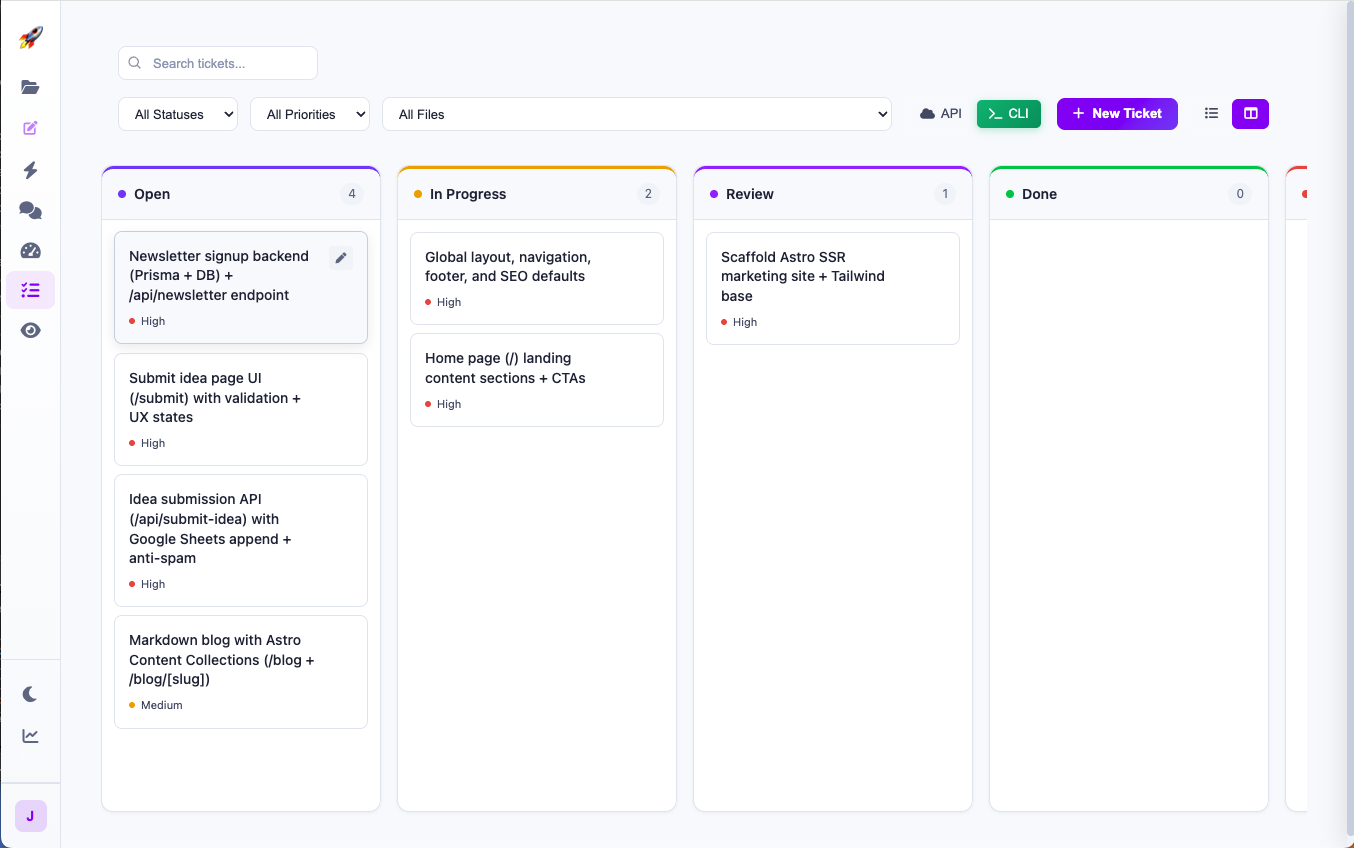
You should not need a status meeting to know whether your software is getting built.
The usual version of this is a weekly call where someone tells you it is going well, and you find out otherwise near the deadline. Here the project record is the actual work: requirements, tickets, what is running right now, what failed, what is waiting on you.
Before you ask
The questions everyone has about outsourcing software.
Most of them come from being burned before. They are fair.
Will you actually understand what I need?
That is the first thing we produce, and you see it before anything is built. Your requirement comes back as a written specification with acceptance criteria — what will exist, how we will know it works, and what is deliberately out of scope. If we misunderstood you, you find out on day one when it costs a conversation, not at delivery when it costs the project.
Will the thing actually work?
Every change is tested and checked against the acceptance criteria it came from before a person reviews it, and a named engineer approves it before it ships. You also get a working preview as it is built, so "working" is something you click on rather than something we assert.
Am I going to spend six months managing developers?
No. There is no standup for you to attend and no team for you to run. You review the specification at the start, look at previews as things land, and approve the finished work. Between those points the pipeline carries the project.
Who owns the code?
You do, unambiguously, and it lives in your repository from the first commit. Not a portal we control, not an account you lose access to if you stop working with us. You can hire an engineer tomorrow and hand it over.
What happens when the requirements change?
They will, and that is normal. Because the specification, the plan and the tickets are all written down and linked, a change is a scoping conversation with a visible cost rather than an argument about what was agreed six weeks ago.
Can you work inside our existing system?
Usually yes. The factory reads an existing codebase as context before it plans anything, which is what makes modernization and backlog work tractable rather than a rewrite in disguise.
What happens after launch?
The project record — requirements, decisions, tickets, tests, documentation — stays with the code. Whether we keep going, your own team takes over, or you bring in someone else, none of it depends on us still being in the room.
Will someone disappear halfway through?
You can see the state of the work at any moment without asking us: what is done, what is running, what failed, what is waiting on you. Projects go wrong quietly when nobody can see them. This one is hard to hide.
Working together
Start small if you want to.
Most people would rather test us on something contained before handing over a project. That is the sensible instinct and we would rather you followed it.
Pilot
One scoped feature or a contained piece of work. You judge the result before committing to anything larger.
Best for testing whether this actually works on your codebase.
Project
Fixed-scope delivery against an agreed specification, with acceptance criteria written down before we start.
Best for a defined build with a defined end.
Ongoing delivery
A continuing stream of work — a backlog, a roadmap, or a product that keeps evolving after launch.
Best for teams without their own engineering capacity.
Pricing depends on scope, so we quote after we understand the work. Send us the requirement and you will get a plan and a number.
If you want the mechanism
What is doing the work
We deliver through the LFG software factory: a pipeline that turns a requirement into a specification, an architecture, a set of dependency-aware tickets, code built in isolated environments, tests, and a reviewed pull request. Coding agents do the implementation. Engineers hold the review gate.
You do not need to care about any of that to work with us — but the reason a small team can deliver this much is not a secret, and you can go and read it.
Give us a requirement.
We will turn it into a technical plan and a delivery proposal. If it is not a fit, we will say so and tell you what would be.
Talk to us about a project