Sentence in, on-brand video out
KiteReach
SaaS product, built and run by our team
KiteReach is a content studio for founders, small businesses and marketing teams who need a steady flow of short-form video and social visuals but don't have a production team. A user pastes their website URL and KiteReach extracts the brand: colours, fonts, logo and tone of voice. From there it produces explainer and animated reels in 12 styles, director-planned short films, and carousels and single images, all in that brand. We built it as one Go codebase with server-rendered pages. Each reel or film is made by a coding agent running in its own disposable Mags sandbox VM, and nothing renders until the user has approved the script and the look. It also includes scheduled publishing, paid-ads support, Stripe billing and bring-your-own-key model access.
Visit the live product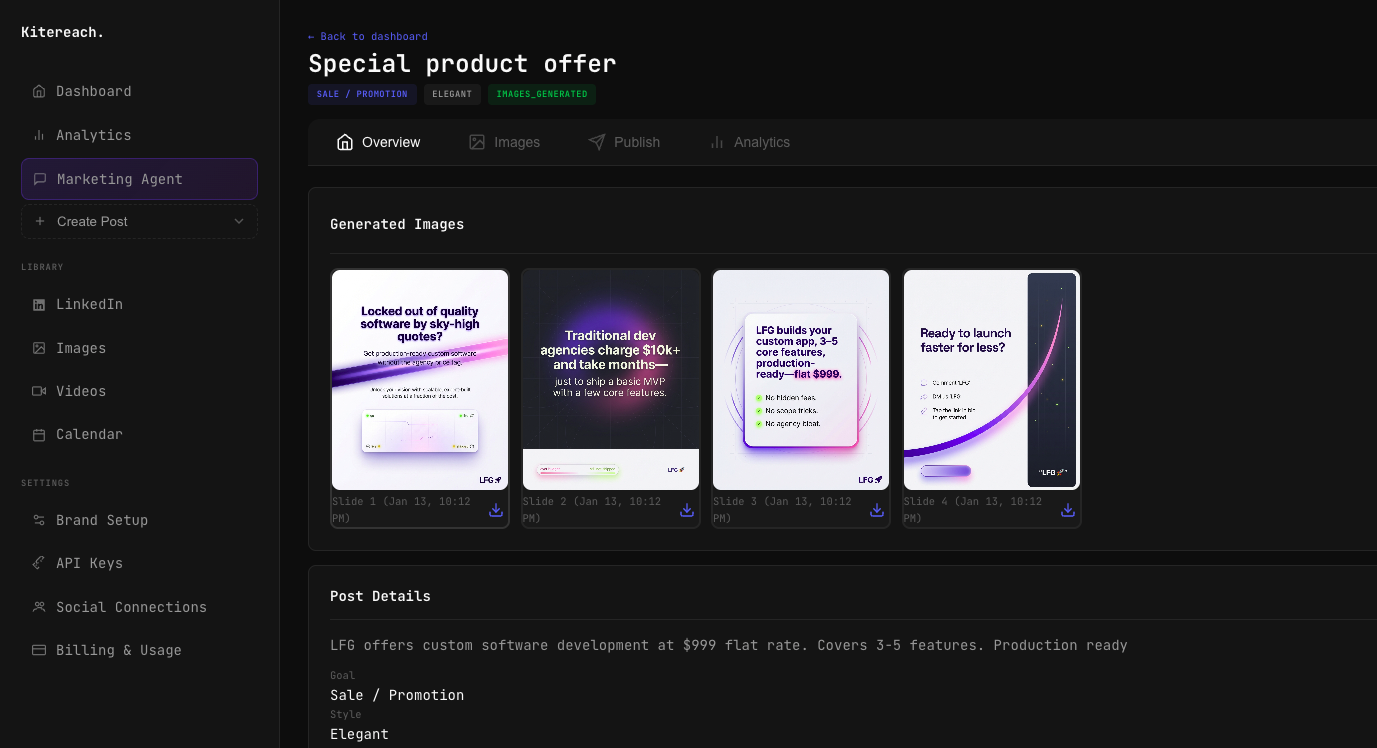
At a glance
- Product type
- B2B SaaS: AI content studio for short-form video and social visuals
- Problem
- Each piece of short-form content is a small production (script, design, animation, voice, music, export), and generic AI tools give off-brand output that can't be edited
- Solution
- Brand extraction, then agent-built reels, films and carousels behind approval gates, rendered in isolated sandboxes
- Timeline
- About 12 months from first commit to the current public plan, with continuous releases
- Engineering
- 188 commits, ~126,000 lines of Go, 34 feature packages, 18 provider integrations, 85 test files (259 test functions), CI with race tests against Postgres, English and Spanish
- Stack
- GoPostgreSQLS3Claude CodeMags sandboxesElevenLabsStripeKamal
The challenge
Short vertical video is now the default format on every major social network, but for a small team each post means writing, design, animation, voice-over, music and export. Agencies are slow and expensive, and generic AI generators struggle with text inside images, characters that change between shots, and output nobody can edit.
Brand consistency
Every asset has to use the right colours, fonts and voice without the user re-entering them each time.
Legible design
Image models paint text badly, and a reel full of garbled captions can't be published.
Long, fragile jobs
A render takes minutes and calls several external models. It has to survive retries, deploys and restarts.
Control
Users need to approve and correct the work at each stage, not just accept whatever comes out.
Many integrations
Publishing, ads, billing, voice, video and image models each bring their own APIs and failure modes.
What we built
Brand setup
- A URL-to-brand extractor that pulls colours, fonts, logo, voice and tone, used as the default for everything generated afterwards.
- An optional deep brand-research step run by an agent in a sandbox.
- Brand profiles stored per account, with ownership checks on every read and write.
Reels made by an agent, not an image model
- 12 reel styles, from 2D explainer and kinetic text to whiteboard sketch, isometric 3D, pixel art and comic book.
- Each frame is built in code (React) and rendered, so text stays sharp and layouts hold. Voice-over is timed word by word.
- Vertical, square and landscape output, with a choice of voice, format and length.
- The user reviews the script before anything renders; progress streams live and runs survive server restarts.
Films with a director and continuity checks
- An AI director turns an idea into a shot list, and the user approves the look before any shot is generated.
- A choice of video model per shot, generated at the lowest suitable resolution to keep cost down.
- Each clip is reviewed as it finishes and can be redone, re-prompted or moved to another model, with continuity carried between shots.
- Levelled audio, music score and narration, plus a content policy and a moderation queue.
Visuals, publishing and ads
- Images and carousels designed in HTML and exported for Instagram and LinkedIn feeds.
- Publishing to Instagram, Facebook, LinkedIn and TikTok, with a scheduler for timed posts.
- Meta ads support with auto-generated creatives and an autopilot mode with spend governance.
Billing and bring-your-own-key
- Stripe subscriptions with a free first reel and a first-run tour.
- Per-user API keys for model providers, so customers can run generation on their own accounts.
Security and operations
- User credentials and API keys encrypted with AES-256-GCM using a rotatable key ring.
- In production the server refuses to start without a strong session secret, an HTTPS base URL, credential keys and billing secrets.
- Ownership checks on every user resource, verified OAuth state, restricted redirects and timeouts on all outbound calls.
- Render jobs use idempotent keys and run in single-use sandbox VMs with per-job secrets that are never stored.
- Deployed with Kamal, with backup and restore-drill scripts and a written production-readiness checklist.
Results
Live and on sale
Running at kitereach.com with public pricing and a free first reel.
Four content types, one brand
Explainers, animated reels, films and carousels, all from one brand profile.
The user decides at each stage
Script, look and per-shot approval gates mean nothing final is produced without sign-off.
Production-ready codebase
CI with race tests, encrypted credentials and startup checks that refuse an unsafe configuration.
Key takeaways
-
1
Have the agent write code, not pixels. Building frames in HTML and React gave readable text and editable layouts that image models could not.
-
2
Approval gates save render time. Approving the script and the look first stops expensive generation being wasted on the wrong idea.
-
3
One disposable VM per job. Running every render in its own sandbox removed stray processes and cross-job interference as sources of failure.
Have a process like this?
Tell us what is costing your team the most time. We will show you how we would scope it, build it and get it into production.